
How Is Cork Furniture Made? From Granules to Stools and Sofas
A maker can press cork granules into a block and then cut the furniture out of it. Jasper Morrison turned his Cork Family on a lathe. Lucie Koldova carved the much larger shell of her Corques sofa. The shapes give away something of the tools that made them.
Making a block from cork granules
A stool can be wider than the thickness of any single sheet of bark. Grinding cork into granules lets a manufacturer build up stock to the dimensions a designer needs. In a bonded composite, the maker selects a grain size, adds a binder and presses the mix in a mould. The finished block gives the workshop enough depth to cut a waist, a foot or a curved seat. APCOR’s account of grinding, bonding and pressing.
Offcuts from stopper production can enter this process. Lucie Koldova’s studio identifies Portuguese bottle-cork factory leftovers as the source for Corques. Turning small fragments into a block makes a striking change of scale possible. The sofa is almost two metres wide. Lucie Koldova’s Corques project notes.
Turning a cork stool on a lathe
In lathe turning the workpiece rotates against a cutting tool. A cut made at one height travels all the way around it. Look at the three members of Jasper Morrison’s Cork Family side by side. Each has a different outline from top to bottom, but every horizontal slice through a given piece would be circular. The turning explains how those broad discs, waists and flared feet belong to a single form. Jasper Morrison’s project record.
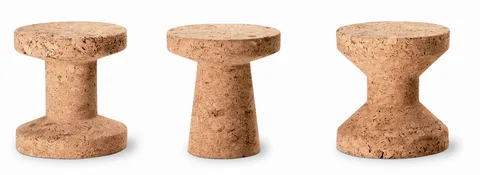
The hourglass on the right is Model A. Its untreated surface exposes grains across the top and down the waist. The cork that supports someone sitting on it also provides the surface beneath a cup when the piece serves as a low table. Examine Model A and its dimensions.
Carving the shell of a two-seater sofa
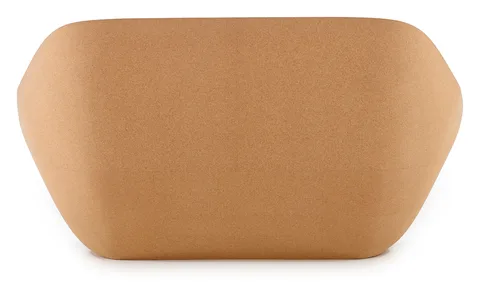
A sofa has a front, a back and two sides. Koldova’s Corques has different curves on each. The back rises higher than the seat, the arms open towards the room and the shell wraps around the upholstered interior. Carving a block of pressed cork lets the designer vary the depth along each of those curves. The rear view makes the extent of the cork especially clear, since the strawberry-red cushions disappear behind it. Compare the front, side and back of Corques.
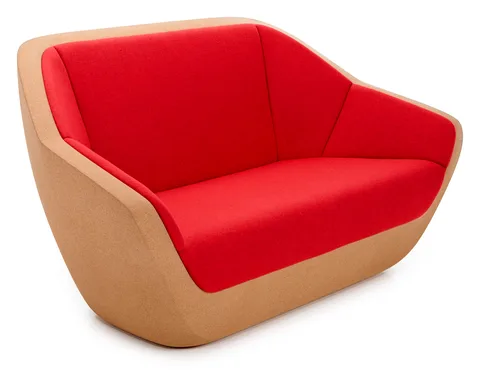
The single-seat version uses the same relationship between shell and upholstery at a different width. Seen alongside the two-seater, it is easier to separate the part that establishes the silhouette from the cushions that receive the sitter. See the Corques armchair.
Reading a workshop photograph
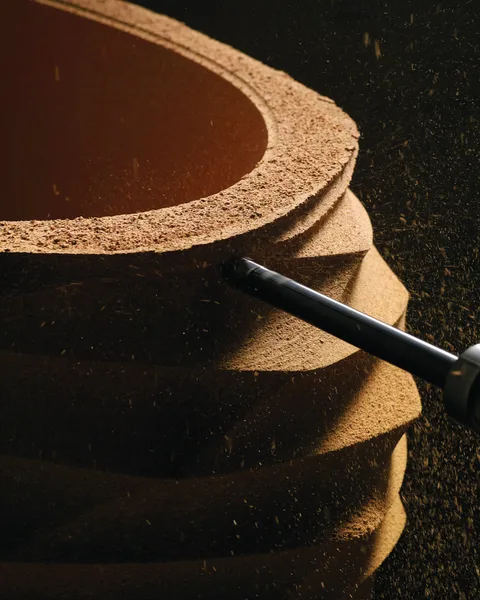
The opening photograph comes from page 18 of the book. It shows a CNC machine cutting a block for a project by Alzira Peixoto and Carlos Mendonça. Along the upper edge, you can see the hollow that has already been cut. Further down, ledges of material still stand proud of the surface. It is a view of work in progress, before the last pass and the finishing of the piece.
That image is a useful companion to the finished furniture. The lathe explains Morrison’s circular sections. Koldova’s carved shell shows how a maker can vary a contour in several directions. The workshop picture lets us see the material that must come away to reveal a contour at all. Explore the cork block before shaping.