
What Is Agglomerated Cork? How It Differs from Bark and Expanded Cork
Agglomerated cork is made by bringing cork granules together into a larger piece. In a composite, a binder holds the grains together. In pure expanded cork, steam and the cork’s own binding substances do that job. A plank stripped from a tree keeps the tissue that grew there in one continuous sheet.
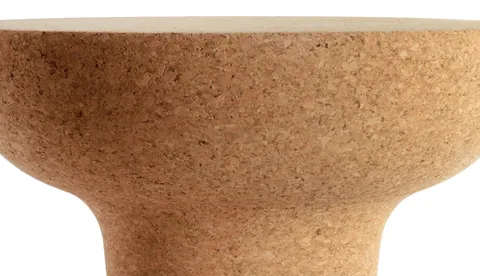
Three ways to make a piece of cork
Look at the edge of a plank in the stack below. Its curvature follows the tree. Now look at the rounded rim of Kenyon Yeh’s Pushpin in the opening photograph. Small, differently coloured particles run right up to its edge. Reading those two surfaces gives a first clue to a material’s history. Finding out how the particles were bonded takes a specification as well as a photograph.
| Material | How it holds together and where it is used |
|---|---|
Natural cork plank 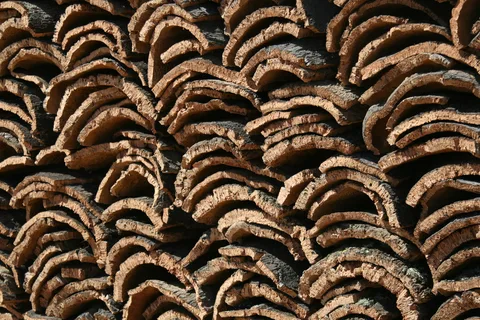 | A continuous layer of bark taken from the tree. A suitable plank can yield a stopper punched in one piece. Its thickness and quality limit what can be cut from it. |
| Bonded cork composite | Granules are mixed with a binder and pressed. Makers can form sheets or blocks and choose the grain size and density for furniture, flooring and other objects. |
Pure expanded cork 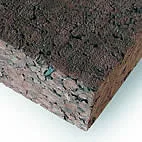 | Steam expands the granules, which bond with substances from the cork itself. Manufacturers cut the resulting blocks into boards for uses including thermal and acoustic insulation. |

APCOR on the route from bark to stoppers. APCOR on composite agglomerates. APCOR on pure expanded agglomerate.
Why grind good cork into granules?
A stopper punch leaves a perforated skeleton of usable cork. Grinding those offcuts produces particles that can fill a mould of quite a different size. The cork industry can also use bark from early harvests, whose irregular structure suits applications such as flooring. In either case, a factory can grade the granules and combine them for the job at hand. APCOR’s description of granulation.
Consider the dimensions of a stool. The broad end of the adult Pushpin is 38 cm across and the piece stands 47 cm high. Making press stock from granules gives the designer room for both the wide dish and the narrow waist. The visible flecks continue over both. The specification identifies the material as agglomerated cork and the version as untreated. Those words answer two different questions, one about the body and the other about its surface. View the untreated Pushpin Adult.
Does agglomerated cork contain glue?
Ask which process the maker means. A composite agglomerate uses a binder, and the mix can also include another material such as rubber. Pure expanded cork is itself an agglomerate, made by a process in which heated granules release their own binding substances. A dark colour or a coarse grain alone cannot establish the recipe. APCOR’s explanation of the steam process.
When you read a material sheet, look for the ingredients of the body, the way they were joined and any finish applied afterwards. The Drop bath mat is a good example because its documentation identifies the rubber as well as the cork and records a separate finish for wear. Read the Drop material sheet in context.