7 Cork Products for the Home and What Each One Does
A cork stool can turn into a table, a cork wall can keep ice cold, and a strip of cork can hold a bottle almost horizontally in mid-air. These seven household objects from Cork Like You’ve Never Seen show what designers can do with the material once it leaves the bottleneck.
Pushpin turns a seat into a side table
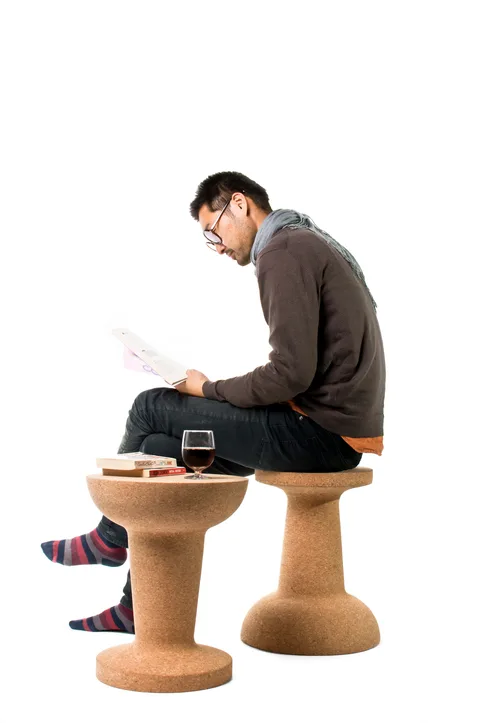
Kenyon Yeh borrowed the outline of a drawing pin, including the difference between its two ends. Set the wider end on the floor and the small flat disc makes a seat. Turn the piece over and the shallow lip on the wide face keeps a book or a cup within its edge. Both surfaces belong to the same body of untreated cork. In the photograph above, two Pushpins beside the reader let you see both uses at once. See Pushpin in both positions.
Gelo keeps a layer of insulation around the ice
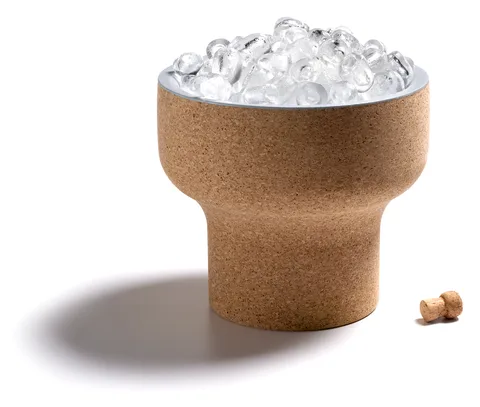
Look inside Filipe Alarcão’s ice bucket. A plastic liner takes the ice and meltwater. A thick wall of agglomerated cork surrounds it, slowing the transfer of heat from the room. The lid closes the one large opening in that wall. Alarcão gave the bucket a narrow foot, so the broad mouth looks almost like the rim of an oversized wine glass. See Gelo with and without its lid. Amorim’s design notes.
Tipsy holds a wine bottle by its neck
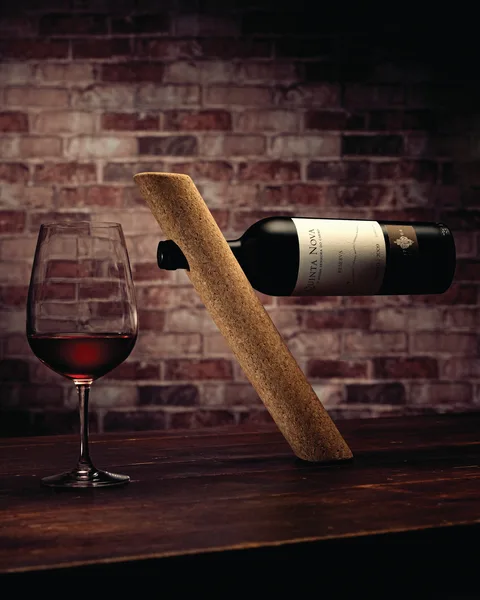
One hole and two angled ends are enough for Keiji Takeuchi’s stand. Slide a bottle through the hole and its weight acts on the sloping length of cork. Together the stand and bottle balance over the small face touching the table. In the photograph, daylight shows under the far end of the bottle. Only the foot of the cork stand touches the table. Look closely at Tipsy’s point of support.
Duo uses one outline for the foot and the shade
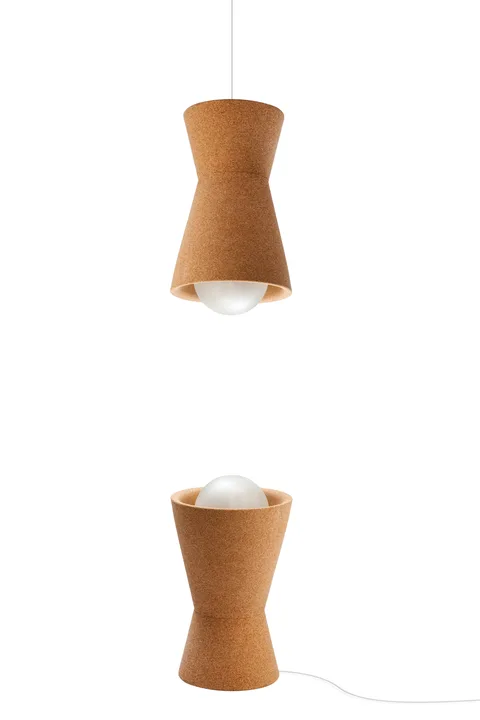
Follow the edge of the table lamp by Alzira Peixoto and Carlos Mendonça. The cork spreads out across the table, draws in at the waist and opens again around the globe bulb. In the studio photograph, its suspended companion repeats the silhouette upside down. Seen as a pair, the two lamps show how the same profile can direct the opening towards the table or towards the ceiling. Explore the Duo table lamp.
Torno gives small objects a place off the desk
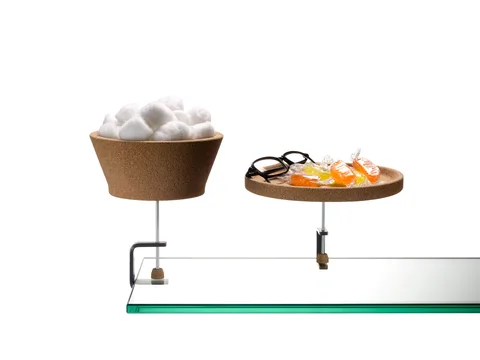
Inga Sempé put a shallow cork receptacle on the end of a metal clamp. The screw below the desk takes the load, leaving the cork above to do the quieter job of keeping loose possessions together. Sempé drew a bowl and a tray for the same fitting. The bowl offers deeper sides while the tray gives you a broader place to set things down. See how Torno attaches to an edge.
The Whistler wraps a ceramic teapot in cork
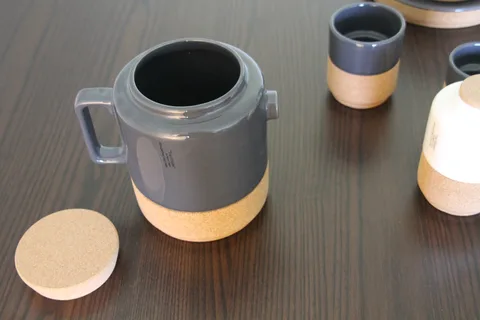
On Raquel Castro’s grey teapot, the glaze tells you where the vessel carries the tea. The cork sleeve fits around its lower body, separating the earthenware from the tabletop. A second piece of cork lifts off the top for filling. The arrangement recalls bark around the trunk of an oak, an association Castro carried into the name of the service. See the Whistler with its lid removed.
Drop brings cork underfoot
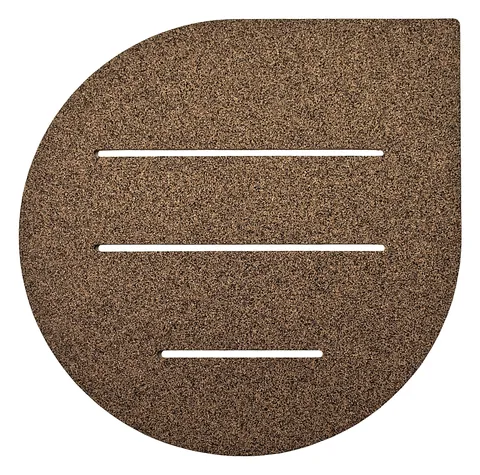
In the Drop bath mat, cork is one ingredient of a flat, speckled sheet. Peixoto and Mendonça combined it with rubber, leaving three openings through which the floor shows. Compare its cut edge with the wall of the Gelo bucket. One object needs to lie close to the floor and the other needs thickness around a cold interior. The material takes a different form for each job. See the Drop material specification. Read how the mat handles water.